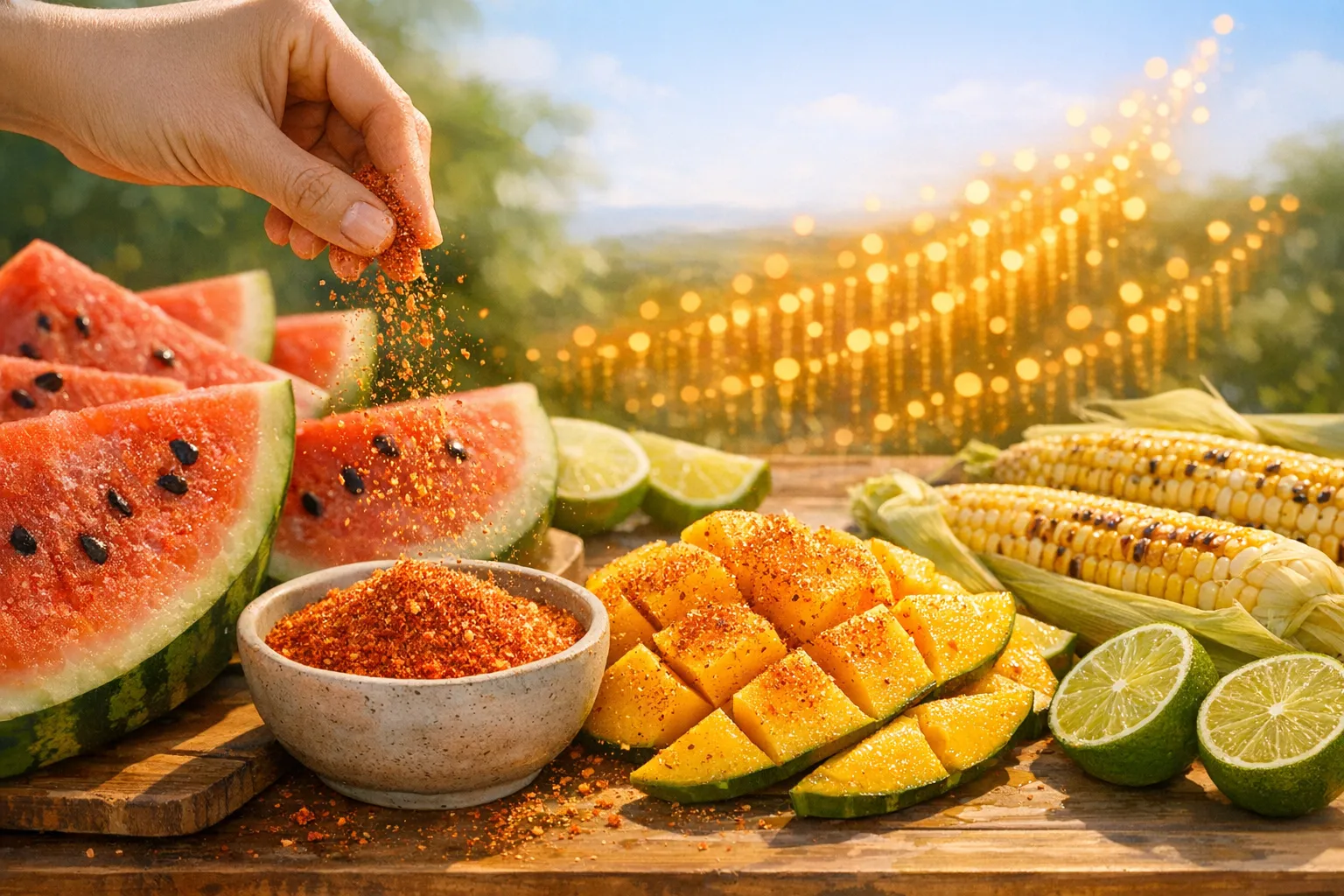
Tajin is the search spelling most people use for Tajín, the red-capped chile-lime seasoning people sprinkle on fruit, vegetables, snacks, and drink rims. The brand's own FAQ describes Tajín as a blend built around chile peppers, lime, and sea salt (Tajín FAQ), which is why the search term often carries recipe, grocery, and "what do I put this on?" intent rather than one narrow shopping intent.
The search move is measurable too: Tajin worldwide hit 26,530 searches on 2026-06-19, up +11.8% vs 7 days earlier and +26.9% vs 30 days earlier. YoY change was +32.2%, the historical peak date remains 2025-08-10, and the 30-day pre-spike baseline was 24,768. The move appears tied to summer fruit season, watermelon retail displays featuring Tajín, and broader spicy-fruit interest.
What Tajin is, and why people search it
Tajin is not just a brand query. It is also a use-case query. A person searching tajin may want the Tajín product, but they may also want pronunciation, ingredients, substitutions, fruit pairings, cocktail rims, or recipes. Tajín's Clásico product page presents the seasoning around mild chile peppers, lime, and sea salt, and positions it for fruits and vegetables (Tajín Clásico product page).
That makes the keyword more interesting than a simple grocery lookup. When searches rise in June, the practical question is not only whether shoppers know the brand; it is whether summer produce, retail displays, recipes, and social food ideas are pulling more people into the same chile-lime flavor moment.
Fast answer: Tajin search volume rose in June 2026 because of summer fruit season, watermelon retail displays featuring Tajín, and wider spicy-fruit interest. The move was meaningful but not an all-time breakout: June 19 volume was 26,530, below the August 2025 peak of 46,671.
What the DailySearchVolume chart shows
The latest observed DSV point for tajin is 26,530 on 2026-06-19. That is up from 23,737 on 2026-06-12, a +11.8% 7-day change, and up from 20,914 on 2026-05-20, a +26.9% 30-day change. The YoY comparison is 20,068 on 2025-06-19, so the current point is +32.2% higher. The 30-day pre-spike baseline is 24,768, while the historical peak date is 2025-08-10 at 46,671.
The move is real but not record-setting. It is above the recent month, above the same date last year, and slightly above baseline; it is still well below the August 2025 peak, so the better read is renewed seasonal demand rather than a new all-time attention cycle.
Searcher intent behind Tajin searches
The same tajin query can come from several needs, so the page should be read as trend intelligence rather than a generic seasoning explainer. These are the main intents to separate when volume rises.
- Trend intent
Example query: “why is Tajin trending”
What they want: the cause of the spike and whether it is seasonal, retail-driven, or social. - Product intent
Example query: “what is Tajin”
What they want: ingredients, flavor profile, brand spelling, and common ways people use Tajín. - Recipe intent
Example query: “Tajin watermelon”
What they want: pairing ideas for watermelon, mango, corn, snacks, and drinks. - Shopping intent
Example query: “where to buy Tajin”
What they want: retailers, nearby stores, pack sizes, and online availability. - Data intent
Example query: “Tajin search volume”
What they want: a search trend chart, daily volume, and comparison terms to judge whether demand is still rising.
Timeline of likely drivers
June 8, 2026: Perishable News said the National Watermelon Promotion Board contest begins June 8, 2026 and runs through August 31, 2026. The timing overlaps the DSV lift and gives shoppers and retailers a concrete watermelon-plus-Tajin occasion.
September 14, 2026: Watermelon Board lists September 14, 2026 as the submission deadline and says Tajín displays can qualify for participation incentives. A long entry window can keep displays, social posts, recipes, and store-level mentions active beyond one announcement day.
June 3, 2026: The Guardian reported that Sous Chef's sales of Tajín were up 19% year over year in 2026 so far. This widens the explanation beyond one produce promotion: fruit-plus-chile flavor demand was already visible in food retail coverage.
June 30, 2025: The Produce News reported Fresh Gourmet and Tajín formed a produce-aisle partnership around chile-lime croutons, pepitas, and masa strips for salad season. The older product push helps explain why Tajin demand may no longer be limited to fruit; savory summer meals can add comparison searches.
Related keywords to compare
Do not read tajin alone. The companion terms show a mixed but useful pattern: watermelon is not rising in the latest 30-day window, while mango is rising week-over-week but still below its May level. That means Tajin's current lift is more specific than a blanket fruit surge, but the YoY strength in both fruit terms keeps the summer-pairing explanation plausible.
Tajin: Worldwide volume was 26,530 on 2026-06-19, with +11.8% 7-day change, +26.9% 30-day change, and +32.2% YoY change. This is the primary spike signal and the best page to track Tajin search volume.
Compare watermelon search volume: U.S. English volume was 37,247 on 2026-06-19, with -3.7% 7-day change, -0.7% 30-day change, and +163.0% YoY change. Seasonal demand is high versus last year, but the latest move is not a short-term watermelon breakout.
Mango: U.S. English volume was 154,312 on 2026-06-19, with +6.8% 7-day change, -19.0% 30-day change, and +214.3% YoY change. Fruit interest remains elevated YoY, but it cooled from the May peak.
Use the Restaurant & Food Search Demand group to monitor food trend keywords and get a wider read on food intent. If adjacent fruit, snack, and restaurant terms rise together, tag the move as seasonal demand. If only tajin keeps moving, treat it as brand- or merchandising-specific.
What marketers/traders/publishers should do
This is the point where Daily Search Volume becomes useful: after the reader understands the thing and the chart, the job is to turn the spike into a repeatable check rather than a one-off anecdote.
- Marketers: Pair Tajin content with specific summer foods instead of generic seasoning copy. Watermelon, mango, corn, salads, and chilled snacks are better test cells than one broad brand keyword.
- Publishers: Build comparison pages and short recipe explainers around the dates above. The article angle should be concrete: what people put Tajin on, where it appears in stores, and how pairings change by season.
- Traders: Treat this as consumer-attention context only. A seasoning keyword lift can help monitor grocery and produce themes, but it is not a standalone signal for any public company.
What not to overread
The chart does not show a fresh all-time high. The 2026-06-19 point of 26,530 is below the 46,671 peak on 2025-08-10, and it is only modestly above the 24,768 baseline. The spike is worth tracking, but do not claim a breakout brand moment unless the next several daily points keep climbing.
What would disconfirm this interpretation?
This interpretation would weaken if watermelon and mango do not move, if tajin falls back below the 24,768 baseline within a week, or if the series fails to make a higher high after 2026-06-19. It would also weaken if retailer and recipe pages stop mentioning the watermelon pairing while search volume remains elevated, because that would point away from the merchandising explanation.
Methodology
Methodology: DailySearchVolume tracks observed daily keyword demand by date, geography, and language. This article uses worldwide volume for tajin, compares the latest point against 7-day, 30-day, YoY, and pre-spike baselines, and checks related terms for corroboration.
FAQ
Why did Tajin search volume spike in June 2026?
Tajin searches rose because several summer signals lined up at once: watermelon season, retail displays featuring Tajín, and broader spicy-fruit interest. The DSV series shows the lift was measurable on 2026-06-19, but the evidence points to a seasonal demand wave rather than a one-day viral event.
Was Tajin at an all-time search high?
No. The 2026-06-19 volume was 26,530, while the current DSV peak remains 46,671 on 2025-08-10. That is why this article treats June 2026 as a meaningful spike, not a record breakout.
What foods are driving Tajin searches?
Watermelon is the clearest named pairing in the June 2026 retail context, but the broader intent also includes mango, corn, salads, snacks, and drink rims. When those adjacent terms move with tajin, the seasonal-food explanation gets stronger.
Is Tajin search interest seasonal?
Yes, the current pattern looks seasonal because Tajín usage clusters around summer fruit, produce merchandising, chilled snacks, and outdoor food occasions. Seasonality does not explain every move, but it is the first baseline to test before assuming a brand-only spike.
How can marketers track Tajin demand?
Marketers can track the tajin keyword, compare it with fruit and recipe terms, and watch whether the latest daily volume stays above the 24,768 baseline. The most useful workflow is to monitor trend direction, not just one daily number.
How to monitor the next move
- Track Tajin search volume after each refresh and record whether the latest value stays above 24,768.
- Compare watermelon search volume with
tajinand mango search volume every two or three days. - Monitor food trend keywords and review Trending; if several summer produce searches rise together, tag the move as seasonal demand.
- Use the Daily Search Volume API to catch seasonal spikes with 7-day and 30-day changes rather than one-day rank alone.
- Update the interpretation after August 31, 2026, when the retail contest window ends; a sustained lift after that date would need a different driver.