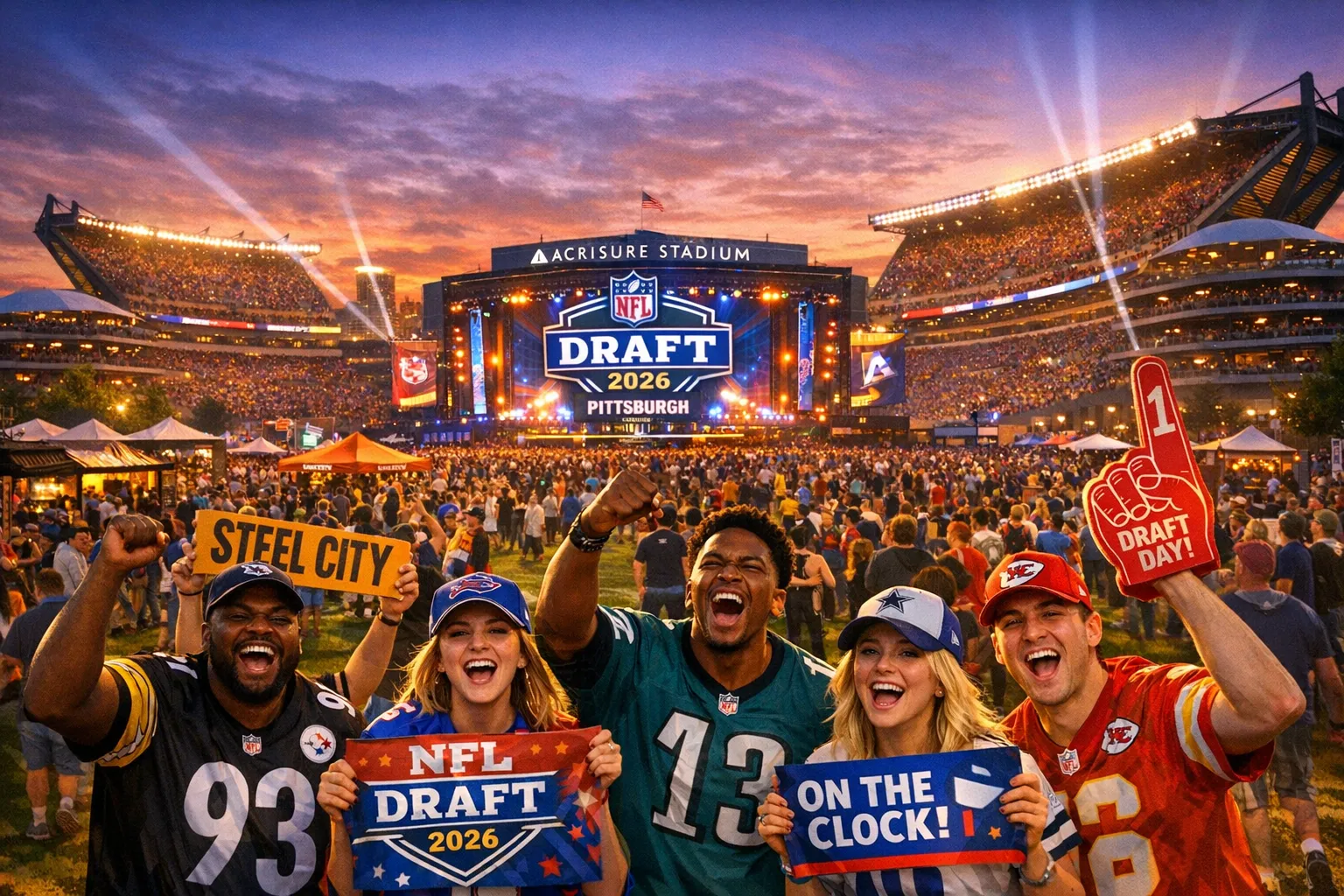
The weeks before the NFL Draft behave like a concentrated attention window: fans research prospects, fantasy players refresh rankings, brands launch limited drops, and local hospitality gears up for visitors. That behavior shows up clearly in query demand—and if you market sports merchandise, regional experiences, fantasy tools, or sports media, treating the draft like a measurable demand cycle beats guessing from headlines alone.
Why April 2026 is the obvious inflection point
The league scheduled the 2026 NFL Draft for April 23–25 at Acrisure Stadium in Pittsburgh, with Round 1 on Thursday evening and the remaining rounds across Friday and Saturday. Major outlets publish consolidated schedules and viewing guides ahead of time, which reliably pulls incremental informational searches from casual fans who only tune in once a year.
For growth teams, the lesson is simple: calendar certainty creates search predictability. When dates and broadcast windows are confirmed, browsers return to canonical queries such as nfl draft, draft order, mock drafts, and team-specific pick outlooks. Those queries rise together—not as random noise—because they share the same underlying event.
What is actually trending (and what that means)
On Daily Search Volume, breakout lists surface keywords that combine momentum across recent daily volume, slope, and percent change. When nfl draft appears alongside other rising queries, it is a signal that interest is heating up across a broad population of searchers—not a single viral post.
That distinction matters for marketers:
- Merch and ecommerce: rising generic draft queries often precede spikes in player-specific gear once picks are announced.
- Content publishers: explainers and schedules capture early demand; pick-by-pick analysis captures event-night demand.
- Local businesses: hospitality and travel intent can move in tandem with nationally televised tentpole events—especially when a host city is known in advance.
The interactive chart uses the same daily volume series as our keyword pages (daily history plus predicted continuation where modeled).
You can inspect the keyword’s trajectory on our public page for nfl draft (en-US) and compare it to other movers on Trending keywords.
Role-specific actions: turn interest into execution
Search demand is not a strategy by itself—it is timing. Pair it with your channel constraints and inventory reality.
- DTC and brand teams: map hero products to the most common sub-intents—first-time explainer readers vs. returning fanatics—and land them on pages that answer the question in the query.
- Agency and SEO teams: coordinate publish dates for evergreen “how to watch” and team need pages with internal links to fresh news updates; daily data helps you see when early-stage research is actually starting.
- Traders and analysts: separate attention from fundamentals. Search lifts can contextualize consumer buzz around sponsors, apparel, or media names, but they are not earnings guidance on their own.
- Researchers: use multiple locales if you compare US interest to international markets; the same event can produce very different query mixes by country.
How Daily Search Volume helps you read the moment
Daily Search Volume is built around daily Google search volume signals, so you can compare a sudden burst to a sustained climb. If you are deciding when to allocate budget, write a brief, or put a sale live, that difference is the difference between chasing a blip and building a plan.
- Start from the home page to run keyword lookups in your market.
- Use Trending for cross-category discovery when you want to see what is broadly heating up.
- For programmatic access—dashboards, internal alerts, or research pipelines—use the API documentation to pull the same signals at scale.
Practical pitfalls to avoid
- Single-day spikes: a headline can create noise; cross-check slope and sustained change when possible.
- Semantic drift: users pack many intents into short head terms; segment with longer queries and landing-page intent where you can.
- Overfitting stories: explain the event (dates, stakes, viewing options) before you claim a business outcome from search alone.
Takeaways
- The 2026 NFL Draft’s fixed April window concentrates informational and fan demand—exactly when generic draft queries tend to accelerate.
- Trend lists that blend momentum metrics help separate widespread interest from one-off outliers.
- Pair keyword timing with channel readiness: onsite content, inventory, creative, and measurement should move together.
To explore nearby demand—or contrast draft attention with cooling categories—open Trending and scan what else is climbing alongside football’s spring peak.